
Chiatura, Georgia – Cable Cars City & Complete Travel Guide
Chiatura is a unique mining town in western Georgia, located about 1.5 hours from Kutaisi. The city is famous for its historic Soviet-era cable cars, dramatic valley landscapes, abandoned industrial architecture, and nearby attractions like Katskhi Pillar and Mgvimevi Monastery.
If you are planning to visit Chiatura from Kutaisi, this guide explains how to get there, what to see, and whether it is worth visiting independently or with a guided day tour.
Industrial Developments
Evidently, the development of Manganese industry gave birth to the Town of Chiatura. It was founded in 1879 with the opening of manganese mines in the area. Furthermore, In 1895, a railway connecteding Chiatura to other cities of Georgia, started to function. By the time there were 6000 people living in Chiatura. At the end of 19th century manganese export from Chiatura amounted to 30% of world export. .
As a result of recent developmemts, Chiatura received the status of a city in 1921. In 1954 the first passenger cable cars in the Soviet Union started to operate here. Specifically about 20 cable car lines start to operate throughout the area. The designer was the famous Georgian Engineer G. Fantsulaia, who also designed cable car infrastructure in various cities of Soviet Union.
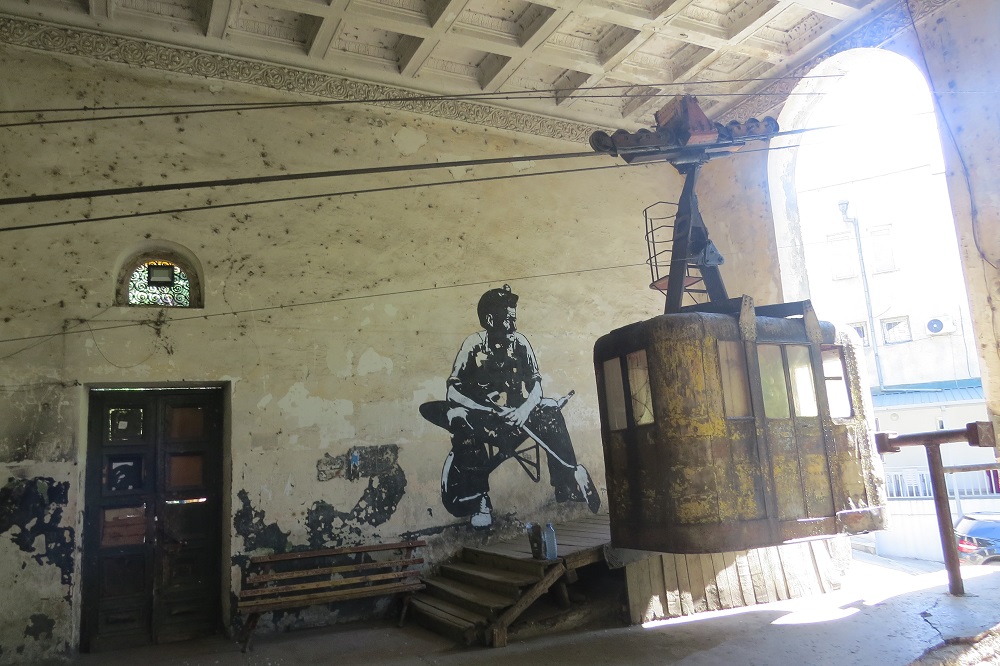
In 2017, the Georgian government began rebuilding the system using modern cable car technology, beginning with the central four-line hub station. As a result, the revamped system opened in September 2021. Shortly afterwards, they considered the original Soviet-era system to be unsafe and taken out of service. The government plans to preserve its Chiatura Cable Cars stations as heritage sites.
How to Get to Chiatura from Kutaisi
The easiest way to reach Chiatura is from Kutaisi, located about 75 km away. Travel time is approximately 1.5 to 2 hours by car.
By Public Transport
Minibuses (marshrutkas) depart from Kutaisi Central Bus Station on Chavchavadze Avenue. The journey takes around 2 hours. Schedules may vary, so it is recommended to check departure times locally.
By Car
Driving from Kutaisi to Chiatura is straightforward and offers scenic views of western Georgia. The road is mostly paved, though some sections may be uneven.
With a Guided Tour
If you prefer a stress-free experience with transportation included, you can join our Chiatura Day Tour from Kutaisi. The tour combines Chiatura cable cars, Katskhi Pillar, and nearby monasteries in one comfortable itinerary.
Plces to visit on the way
Top of the list undoubtedly takes the Katskhi pillar. It is a natural limestone monolith located at the village of Katskhi. The pillar is approximately 40 metres (130 ft) high, and overlooks the small river valley of Katskhura. Certainly, The rock, with visible church ruins on a top surface (150 m), has been venerated by locals as the Pillar of Life and a symbol of the True Cross. The studies determined the ruins were of an early medieval hermitage, dating from the 9th or 10th century. A Georgian inscription paleographically dated to the 13th century suggests that the hermitage was still extant at that time. Religious activity associated with the pillar was revived in the 1990s and the monastery building had been restored within the framework of a state-funded program by 2009.
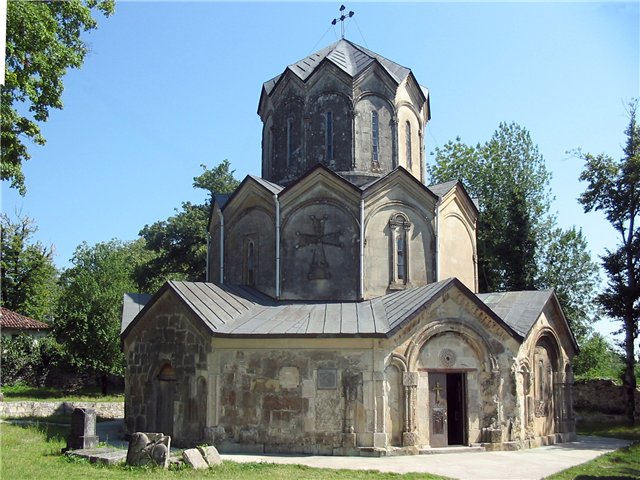
The Katskhi Monastery is another historical site in our Chiatura Travel guide. It is located in the village of Katskhi in a few hundred meters from the pillar. Baguashi Family, one of the powerfull local rulers, built the monastery in the period of 988–1014. Unlike tipical Georgian architecture, the church building has a hexagonal design and rich ornamentation. Soviet government closed down the monastery in 1924. Later, In 1990th Monastery opens its doors under the patronage of the Eparchy of Sachkhere and Chiatura of the Georgian Orthodox Church.

Things to do in Chiatura
Sites in our blog:
- Chiatura House of Culture;
- Chiatura Pioneers Palace;
- Chiatura Cable cars of Sashevardno;
- Chiatura Cable Cars of Tsofi-Avarioni;
- Chiatura Cable Cars of “Chiqaura”
- Mgvimevi Monastery
- Chiatura Stadion;
- Steam Trains graveyard;
- Chiatura Drama Theater;
House of Culture

Generally, the best way to start exploring Chiatura, Cable Cars City, is to visit the House of Culture. Herewith you may find a small ethnographic museum. The exhibits are very interesting, dating back to as far as the stone age. It’s better to begin with reaching a local guide, having office in the same building (price about 10 gel). Here you may find paintings, equipment, models or machinery associated with the mining industry of Chiatura.


Chiatura Pioneers Palace
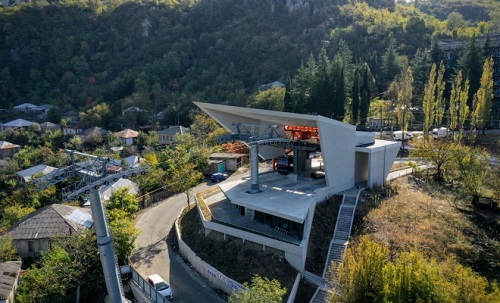
At the side of a House of Culture there is modern, newly built Chiatura Cable Cars station, which brings you to the hill overlooking Chiatura City.

Shortly, after you exit , Pioneer Palace and a small amusement park appears to the right. It was built in the first half of the 60’s by a Georgian Architect Chxeidze. You may find similar structures in Tkhibuli and in Tkhvarcheli. The Pioneer Palace hosted scientific, educational and art classes. It also functioned as an event hall and housed a museum as well. The building was functional till 2007, after which it was completely abandoned. Government didn’t support maintenance and protection of the structure. It was robbed and pillaged several times. Eventually they opted for the demolition of the amazing building. Although, civil activists were successful in stopping the process and saving the remaining fragments of the building.


Chiatura Cable Cars station
Imagine being whisked away on a Chiatura cable cars, soaring high above the city. As you ascend, the city’s history unfolds below. It’s not just a journey; it’s a panoramic time machine, revealing Chiatura’s past in every breathtaking view. As you glide through the air, the cable car becomes your storyteller. Chiatura’s industrial saga unfolds beneath you – a city shaped by manganese, mining, and the resilient spirit of its people. It’s not just a ride; it’s a historical odyssey, with each glide unveiling a new chapter.
Chiatura Cable cars Station “Sashevardno”
It;s worth mentioning, that cable car station “Sashevardno” was the first one to open in Chiatura. You may notice it on the crossroad at the center of the city. Herewith you may find the most popular image of a miner making Chiatura destination famous.
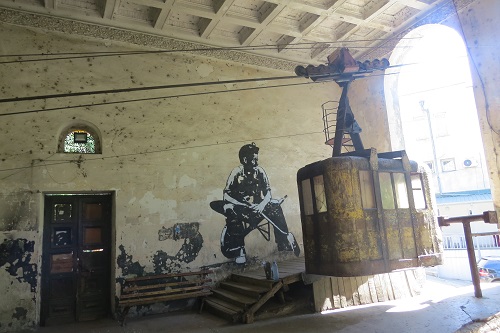


The banner on the wall says:
- Built in 1966;
- Length of the route – 250m;
- Time to travel – 1.7 minutes;
- Speed – 2.8m/second;
- Angle – 48 degrees;
- Altitude between the ground and top station – 186 meters;
- Passengers allowed – 4 people;
- Waiting time at the station – 10 minutes;
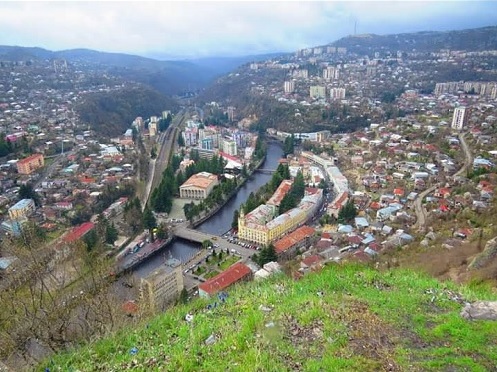
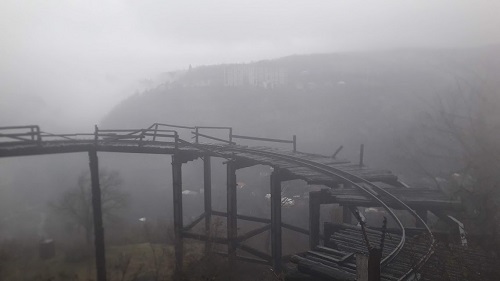
In fact there are 2 categories of stations. Ground station, built on a City level on one hand and hill top stations on another hand. Hill top station of Sashevardno is also worth a visit. The cabin of an operator is hanging over a cliff in the air. Its about 1 sq. m and exposed to wind, snow and rain.


At the hill top station there is the entrance to the mines. You can not only observe some industrial equipment and machinery, as capture beautiful views over the City as well.
Chiatura Cable Cars Station “Chikaura”
It’s time to get back to Cable Car Station N1 or “Sashevardno” and head to the direction of Sachkhere. after a 5 minute drive, you may find Chikaura ground station to your left. it connected to Mghvimevi and Saphari hill top stations (located at opposite sides from each other) forming a V shape.
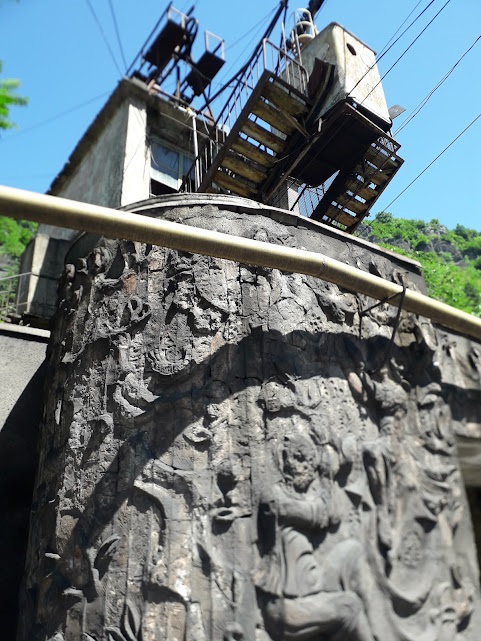
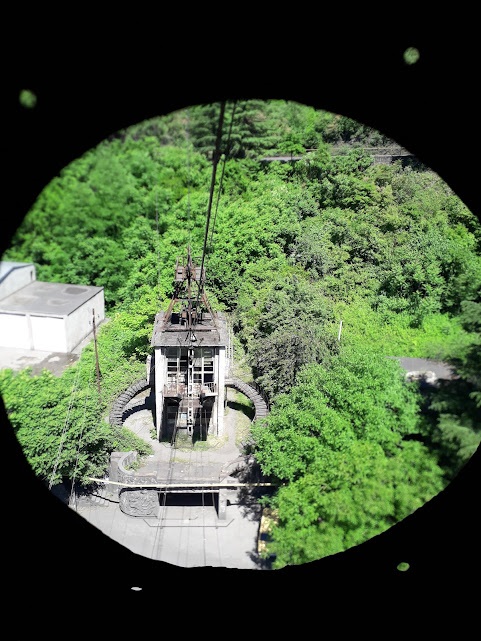

- Built in 1966;
- Length of the route – 500 (both directions);
- Time to travel – 2.5 minutes;
- Speed – 2.4m/second;
- Altitude between ground and hill top station – 150 meters;
- Passengers allowed – 6 people;
- Waiting time at station – 10 minutes;
Mgvimevi Monastery
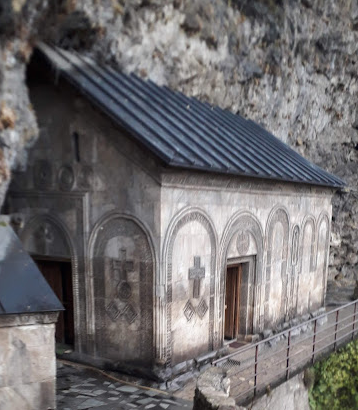
Following our schedule to Chiatura cable cars, we could not skip amazing monument of Georgian Church Architecture, Mgvimevi Monastery. Its main highlight is a 13th-century two-nave basilica, dedicated to the Nativity of the Mother of God. The complex also includes a small hall church, bell-tower, and a circuit wall. At this time the monastery is a functioning nunnery. It is rich in ornamental architectural sculpture which decorates the exterior of the churches. The Mghvimevi complex is inscribed on the list of Georgia’s Immovable Cultural Monuments of National Significance.
Chiatura Cable Cars Station “Tsofi- Avarioni”
Just a few minutes drive to the direction of Sachkhere, you may find another Cable Car station Tsofi – Avarioni Station. Tsofi is a name of the ground station and manganese factory nearby. Avarioni – hill top station and the settlement on the hill connected by cable car.
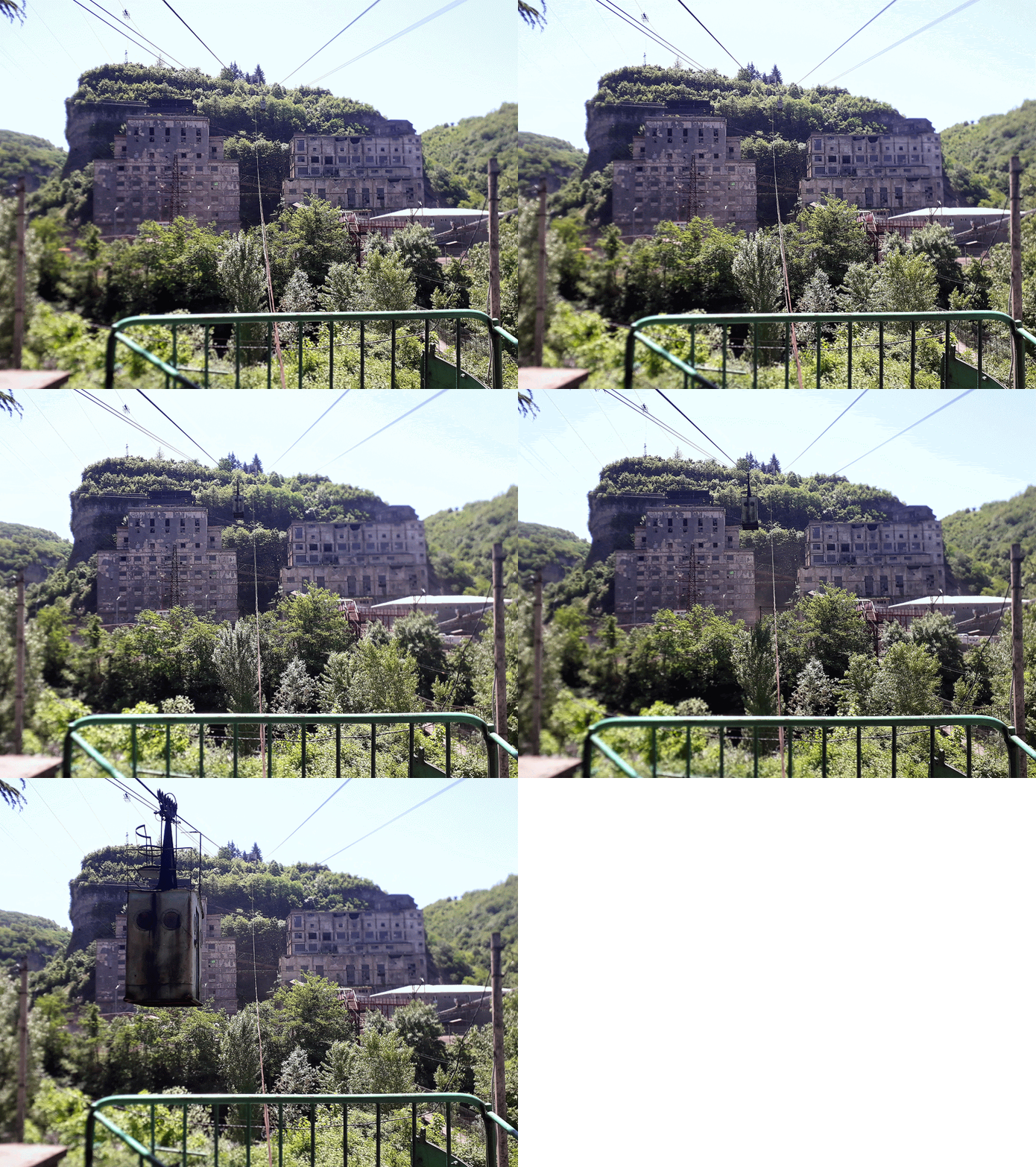
Short information:
- Built in 1971;
- Length of the route – 320m;
- Time to travel – 3 minutes;
- speed – 2.4m/second;
- Altitude between ground and hill top station – 91 meters;
- Passengers allowed – 4 people;
- Waiting time at station – 10 minutes;
Chiatura Stadium
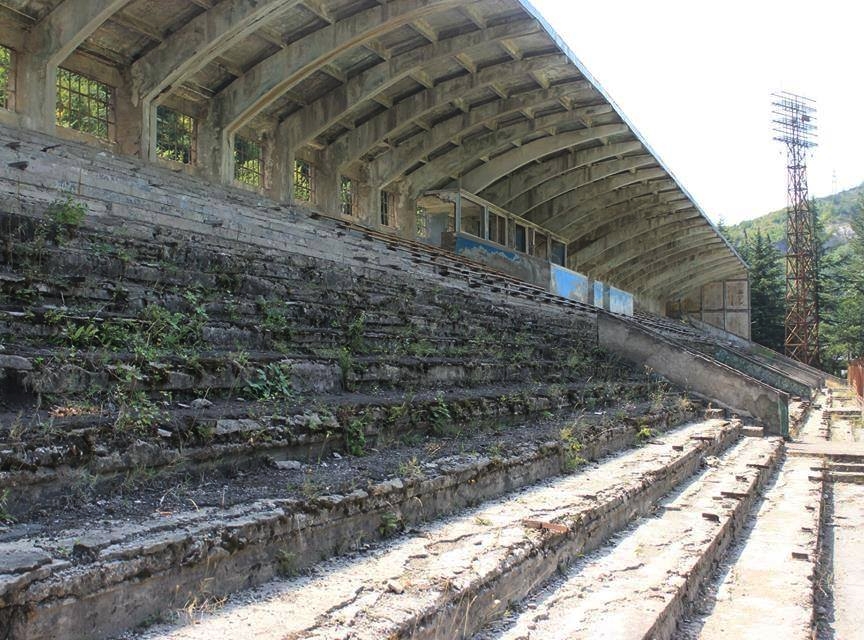
After the Chiatura Cable Cars stations, let’s discover obviously, true example of Soviet Architecture Temur Maghradze Stadium. It was open to visitors in 1969, and may accept 11 500 spectators. The stadium is a home arena of FC Chiatura.
Founded in 1936, it was named Magharoeli (Miner in Georgian) at Soviet times. Earthquake in 1991 damaged stadium infrastructure, but it’s still accepts home matches of FC Chiatura.
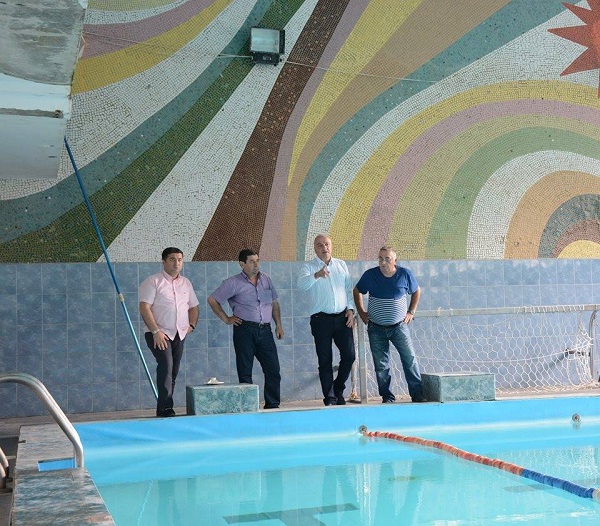
Chiatura pool
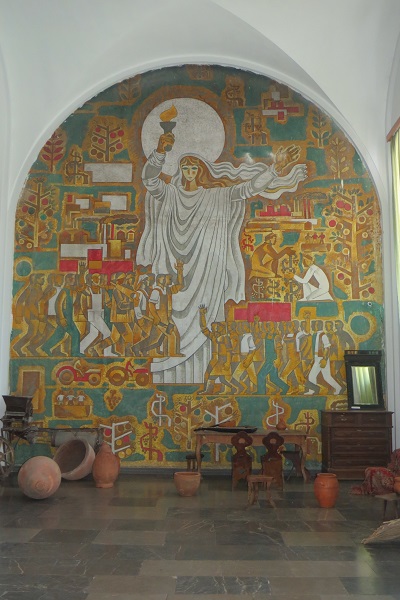
In the Sport complex there is pool, which keeps some of the interesting mosaics of Soviet time.

Steam Trains graveyard
During exploring Chiatura Stadium, You may encounter old steam trains abandoned sit.e There are a few trains produced at soviet times. It’s possible to get on the train and have a look from the inside.


Chiatura Drama Theater
On the way back to the city center it could be interesting stop at the Chiatura Drama Theater for a few minutes. In the frontal part of the building there is a monument of Akaki Tsereteli. He was Initiator of a Manganese discovery and exploration process in Chiatura. As well as a public figure and a famous writer.
A. Tsereteli was a friend of Ilia Chavchavadze, a Georgian progressive and intellectual leader of the youth. The young generation of Georgians during the 1860s, led by Chavchavdze and Tsereteli, protested against the Tsarist regime and campaigned for cultural revival and self-determination of the Georgians.
He is an author of hundreds of patriotic, historical, lyrical and satiric poems, also humoristic stories and an autobiographic novel. Tsereteli was also active in educational, journalistic and theatrical activities.
At the end of XIX century, several theaters were opened with the efforts and initiative of the Georgian public figures. One of them was the Tchiatura Drama Theater, starting form 11 December 1894. In 1901 sensational play “Little Kakhi” was staged in the theater, in front of its author, the famous Georgian writer – Akaki Tsereteli. Since 1910 the theater has constant troupe.

Frequently Asked Questions About Visiting Chiatura
Is Chiatura worth visiting?
Yes, Chiatura is one of the most unique destinations in western Georgia, known for its historic cable cars, dramatic valley landscapes, and industrial heritage.
How long do you need in Chiatura?
Most visitors spend 3–5 hours exploring the cable cars, viewpoints, monasteries, and nearby attractions like Katskhi Pillar.
Are Chiatura cable cars still operating?
Some modern cable car lines are operating, while parts of the old Soviet-era system have been preserved as historical infrastructure.
Can you visit Chiatura independently?
Yes, it is possible to visit independently by public transport or car, but a guided tour from Kutaisi makes logistics easier and allows you to combine multiple attractions in one day.

One thought on “Chiatura, Georgia – Cable Cars City & Complete Travel Guide”